Posts

Might the practice of yoga Nidra be the new prescription for mental health?

I’ll never forgot my first exposure to a relaxation technique. It was long before my discovery of yoga and my journey of becoming a licensed mental health provider. I was at a work conference and it was an optional gathering at the end of a long day of attending educational sessions. I don’t know what led me there, yet I am forever grateful. The technique was progressive muscle relaxation, where you tense a specific muscle group for about 5 seconds and then release it for 30 seconds and move through the entire body from toes to face. It was so powerful for me as it made me aware of how much tension I held in my body and allowed me to experience deep relaxation, perhaps for the first time in my life! Fast forward 40 years, I now am a big proponent and teacher of yoga Nidra, which offers a more gentle route to physical sensation awareness and deep relaxation. Could such a practice be the new prescription for mental health?

If you live a stressful life (and who doesn’t in this day and age), chronic stress impacts our mental health, inviting in symptoms of anxiety and depression. All of us having the opportunity to read this blog survived a global pandemic, which was traumatizing and contributed to the global mental health crisis. Stress, anxiety and depression pose major public health concerns, yet conventional interventions, such a prescription medications and talk therapy, have shown limited success in addressing these multifaceted issues. The limitations have encouraged researchers to think outside of the box and explore complimentary and alternative solutions. The amount of research around contemplative yogic practices has grown significantly over the past several decades. Yoga as a practice typically can include movement, controlled breathing, and some opportunity for stillness or meditation, so research struggles to identify what specific parts of the practice have the most impact on our brains and mental health. Overall, the research does suggest that yoga practices have many mental health benefits.

However, not all yoga practices are accessible to everyone. Yoga Nidra is a meditative practice and has gained momentum over the past decade as a potential holistic approach to mental health care. The practice can be offered online and several sites, including UCLA Mindful, have free guided meditations translated into multiple languages. But does it help to reduce symptoms of stress, anxiety, and depression? Well, a recent meta-analysis of 73 studies involving 5,201 participants showed significant benefits of yoga Nidra for exactly these symptoms, reinforcing this practice’s therapeutic potential!

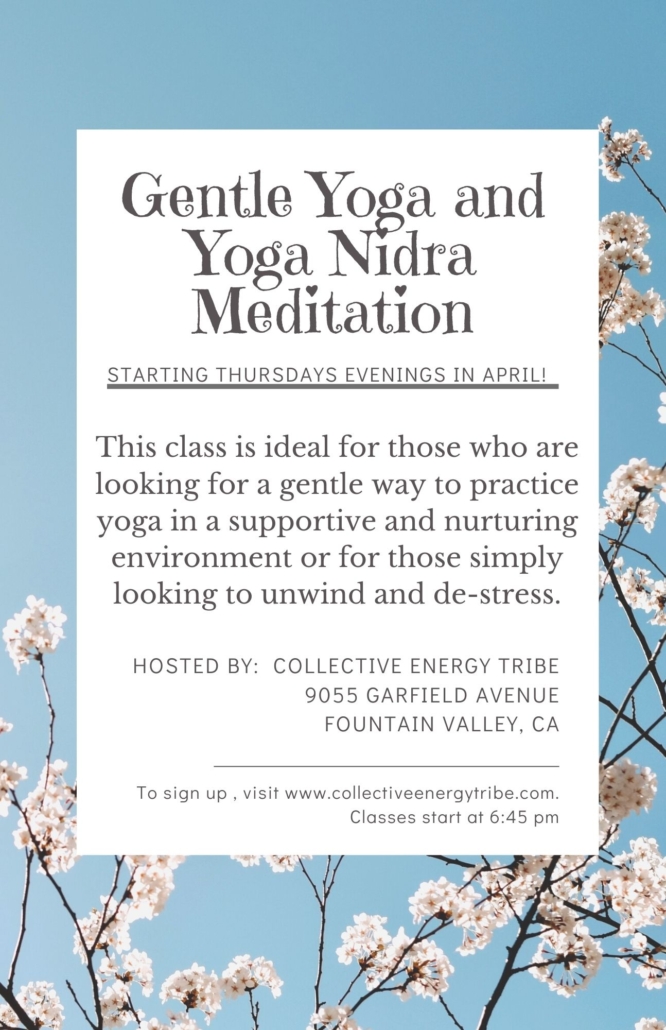
New Spring In-person Yoga Class!

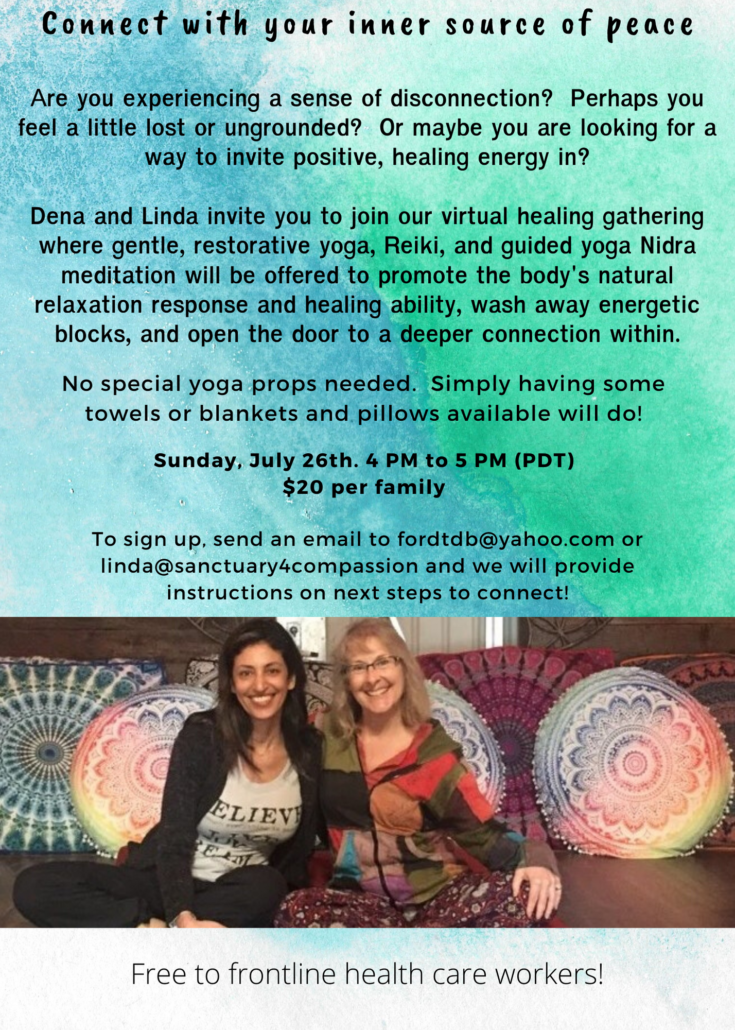
Online Reiki-infused yoga, sound healing and meditation class!

This online group gathering will be conducted using Zoom’s video conferencing, which provides an option to turn off the your audio/video at any time, supporting privacy and facilitating a reduction in distractions.  For first-time attendees, signed release of liability/waiver forms will be needed.  Once these forms have been received, along with payment via PayPal, an email will be sent to you with the link and meeting ID to join the class.  We look forward to being of service to you!

Virtual Community Gathering Practice Tips

We understand that this is not the ideal way to come together to practice and how sometimes just the thought of more technology might bring shivers down our spines.  Accepting that it’s OK to feel intimidated is the first step. We are doing our best to make the connection simple and easy.  Harnessing the warrior energy within will help you to face any tech fears you might have and join us!

Once you let us know that you are interested in attending, we will send you an email that will include details around what is needed from you, including:

  • Signed Releases/Waivers of Liability forms (one time, for new students only)
  • PayPal information to facilitate payment
  • Checking your email for the Zoom link to join the class
  • A few minutes before the class, simply clicking the link within the email to be sent straight to our meeting room

To facilitate the benefits of such a virtual community practice at home, below we have provided some helpful hints:

  • Set up your mats at least 3 giant steps from your device.
  • Elevate your device 21-24″ from the floor and have it tilted forward slightly.
  • Have your props nearby.
  • Although not required, having a headset or ear buds to listen when the singing bowls are playing may enhance your listening pleasure.
  • Please know you will not need to have your audio/video camera on during the practice.  If you would prefer to reduce the number of distractions or increase the sense of privacy, we invite you to turn off your audio and video once the class starts.

Restorative Yoga Tips and Props

On the day of the class, here are some additional recommendations to create a more sacred space in advance for your practice:

  • Make sure you’ll be in a space where there won’t be any background noises, distractions or interruptions.
  • Adjusting the lighting in the room to your liking, perhaps turning off any overhead lighting and minimizing outdoor light and instead turning on a room lamp or lighting your favorite candle(s).
  • Wear warm, comfortable clothing including socks.
  • If available, bringing your favorite deck of intention cards and essential oil to your mat.
  • Placing your props (see below) to the side of your mat so they are within an easy reach during the class.

 In home prop ideas:

  • Bolster:  couch cushions or a tightly rolled comforter, towel, or blanket (can be secured with 2 ties, scarfs or belts)
  • Pillows:  couch, chair or bed pillows will do
  • Blankets:  your favorite blanket to cover yourself and either 2 additional blankets or bath or beach towels (no sheets)
  • Yoga blocks: books, either paper back or hard cover, stacked
  • Eye pillow:  hand towel, tie or scarf

Will physicians start prescribing yoga for hypertension soon?

Both of my parents have a diagnosis of hypertension and were put on antihypertensive prescription medication to control it.  I think my mother received the diagnosis in her 30s.  I was turning 40 when I first heard my physician say my blood pressure was “elevated” and wanted it monitored in order to determine if I too would need to be put on some medication.  Boy, am I glad that shortly after that I discovered yoga!

I found yoga while celebrating my 40th birthday in Neversink, NY at the New Age Health Spa.  I recently learned that this place closed down a couple of years ago, which made me a little sad to think that it truly launched me on a path toward holistic health and wasn’t able to sustain itself, unlike the riches the pharmaceutical companies rake it.  The first things I noticed after practicing yoga initially were that my low back pain (from bulging/herniated discs) went away and the chronic tension in my body began to lessen.  The best news though was when I went back to the doctor’s office and was told my blood pressure was back to “normal”.  Now, after many years of practice, my blood pressure is actually considered “low”!

This dramatic change in one of the leading causes of morbidity in my own experience – and one in which prevented the need for a life-long attachment to a prescription medication – was all the motivation I needed to continue to explore the benefits of a yoga practice, eventually leading me to becoming a teacher to offer such healing benefits to others.  Unfortunately, my individual story doesn’t equal proof of a connection, so it has taken many years for the research to show that yoga does have a positive effect on your blood pressure.

In a recent systematic research article review that included 49 clinical trials, the data now show that yoga, when breathing and meditation practices are included, is a viable antihypertensive lifestyle therapy.  It is in moments like these that I would like to say “I told you so”!

If you would like to read more on this recent research, please click the button below: